Dermatology · The Full Picture
The Drug That Literally Changed Faces — and Lives
Everything you actually need to know about isotretinoin — its history, how it works, standard vs NF dosing, and the honest truth about side effects.
A proper read · 8 minutes
Let’s start with the number that matters most: 85%.
85% of people who complete a course of isotretinoin achieve clear — or near-clear — skin. Not managed. Not suppressed. Clear. For a disease that affects hundreds of millions of people and causes genuine psychological damage, that figure is extraordinary. No other acne treatment comes close.
And yet isotretinoin remains one of the most misunderstood, feared, and misrepresented drugs in modern medicine. So let’s fix that.
Where it came from
It Wasn’t Even Meant for Acne
Isotretinoin was synthesised by Hoffmann-La Roche in the 1960s. The target? Cancer. Researchers were studying how retinoid compounds affected cell proliferation. Nobody was thinking about skin.
Then dermatologist Gary Peck at the NIH started administering it to patients with severe skin disorders — and watched something remarkable happen to their sebaceous glands. The oil-producing machinery that drives acne was being switched off.
1960s
Roche synthesises isotretinoin. It’s a cancer research tool. Nobody’s thinking about spots.
1970s
The NIH discovers its effect on sebaceous glands. The “Acne Mafia” — a trio of leading dermatologists — begins pushing for clinical trials.
1982
FDA approval as Accutane. The first oral drug to produce lasting acne remission — not just suppression. Still the most effective acne treatment ever discovered.
2002
The iPLEDGE programme is mandated in the US — one of the strictest drug safety programmes in pharmaceutical history, specifically to prevent use during pregnancy.
2010s–Now
Next-generation NF (new formulation) versions emerge — same molecule, dramatically better delivery. A quieter revolution that most patients don’t even know about.
The science, simply
Why Nothing Else Comes Close
Acne isn’t one problem. It’s four happening simultaneously — which is why antibiotics and topical creams only ever solve part of it. Isotretinoin is the only treatment that hits all four at once.
🫙
Sebum Production
Shrinks sebaceous glands by up to 90%. Cuts off acne’s primary fuel source.
🔬
Clogged Pores
Normalises skin cell turnover. Stops dead cells blocking follicles — the trigger of every pimple.
🦠
Bacterial Growth
By eliminating their food source, it controls C. acnes bacteria — without being an antibiotic.
🔥
Inflammation
Suppresses the cascade that turns a blocked pore into a scarring, painful nodule.
“Isotretinoin achieves something no other drug manages: long-term remission. Not suppression — actual remission. The science has evolved for 40 years. Its supremacy hasn’t.”
Standard dosing
10mg, 20mg, 30mg — How the Maths Works
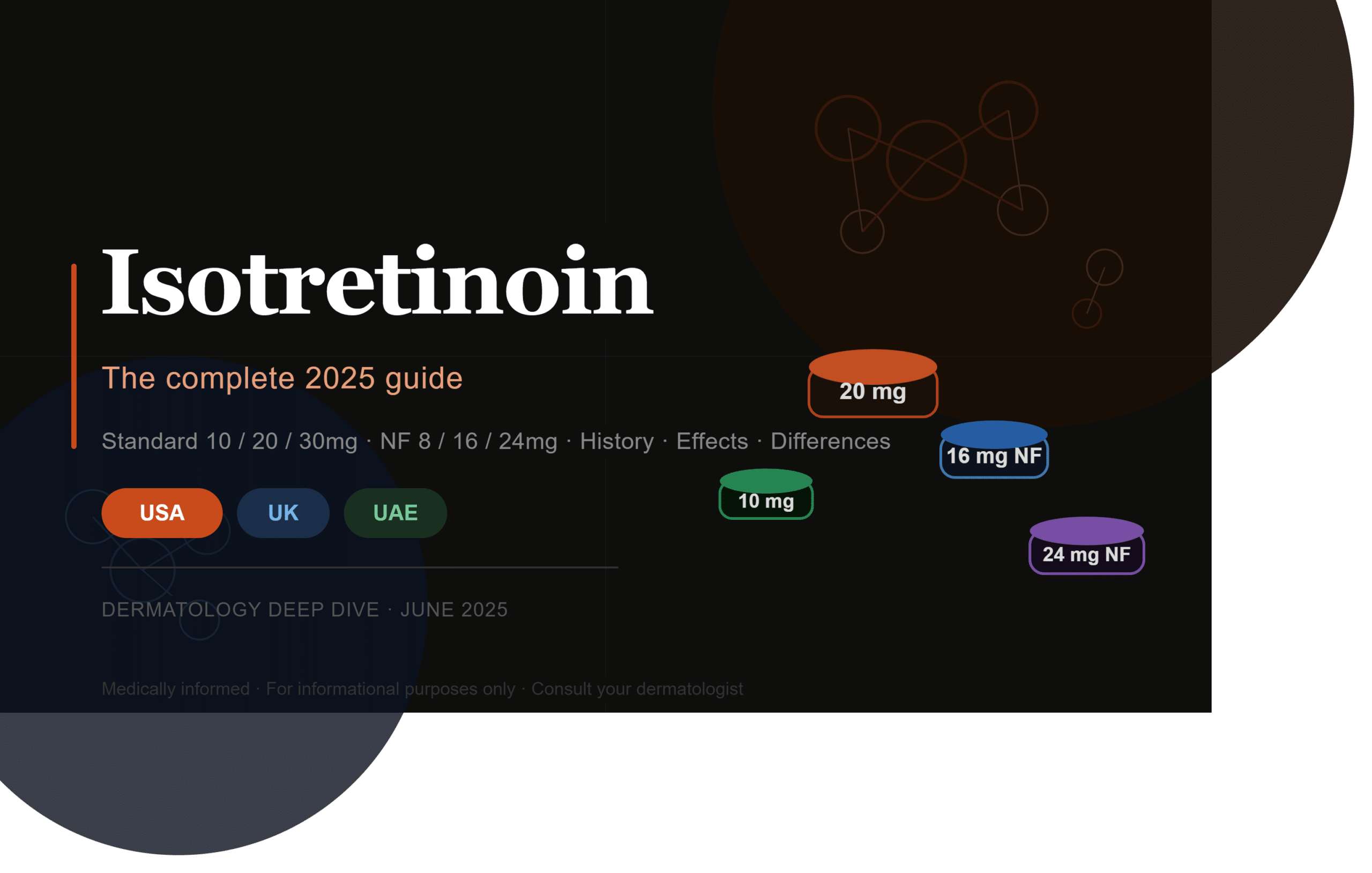
Your doctor doesn’t just pick a dose out of the air. It’s weight-based — targeting a cumulative dose of around 120–150 mg per kilogram of body weight over the course of treatment. Here’s how the standard strengths break down:
| Strength | Typical Patient | Course Length | Food Required? |
|---|---|---|---|
| 10 mg | Starting dose / adolescent / low weight | 6–9 months | Yes — fatty meal |
| 20 mg | Average adult under 70 kg | 4–6 months | Yes — fatty meal |
| 30 mg | Heavier patients / higher severity | 4–5 months | Yes — fatty meal |
The bioavailability problem
Standard isotretinoin has roughly 20% bioavailability when taken without food. Take it with a high-fat meal and that nearly doubles. Miss that window — and you’ve wasted a significant portion of your dose. This inconsistency is exactly what the NF generation was built to solve.
The NF revolution
8mg, 16mg, 24mg — The Same Drug, Delivered Better
Here’s something that surprises most patients — and even some clinicians. A 16 mg NF capsule delivers the same therapeutic drug exposure as a conventional 20 mg capsule. You’re taking less. Your body is absorbing more of it, more reliably.
NF formulations use technologies like LIDOSE® lipid matrix and SEDDS® (Self-Emulsifying Drug Delivery Systems) to dramatically increase the drug’s surface area and solubility. The result is higher, more consistent bioavailability — and crucially, it works whether or not you’ve eaten.
| NF Strength | Equivalent Standard Dose | Food Needed? | Brand Examples |
|---|---|---|---|
| 8 mg NF | ~10 mg standard | No | Absorica LD, Aknekutan |
| 16 mg NF ★ | ~20 mg standard | No | Absorica, Aknekutan |
| 24 mg NF | ~30 mg standard | No | Absorica, Aknekutan |
Bottom line on NF
The pharmacokinetic advantage is real, peer-reviewed, and clinically meaningful. For patients who previously had poor results or unpredictable side effects on standard isotretinoin, NF formulations are a conversation worth having with your dermatologist.
No sugarcoating
Side Effects: Honest, Complete, Unfiltered
This drug works because it’s powerful. Knowing what to expect — and how to handle it — makes the difference between a course that breaks you and one that changes your life.
What almost everyone experiences:
- Dry lips — Near-universal. Get a thick lip balm before day one and keep it everywhere.
- Dry skin — Fragrance-free moisturiser, always. Drop any harsh cleansers immediately.
- Dry eyes — Preservative-free drops. Contact lens wearers often need a break.
- Initial flare (“the purge”) — Many people get worse in weeks 2–6 before improving. Expected. Not a sign it’s failing.
- Sun sensitivity — SPF 50 daily. No tanning booths. Non-negotiable.
The mental health question
The relationship between isotretinoin and depression is one of dermatology’s most debated topics. Current evidence doesn’t establish a definitive causal link — and some studies suggest severe acne itself causes depression that resolves with treatment. But any patient experiencing mood changes should contact their doctor immediately. This is a reason to be monitored, not a reason to avoid treatment.
Serious risks that are monitored with regular blood tests: elevated liver enzymes (avoid alcohol entirely), elevated triglycerides, and prostate/PSA in relevant cases. These are tracked — that’s the point of monthly monitoring.
For women of childbearing age — isotretinoin causes severe birth defects. The iPLEDGE programme exists for exactly this reason. Contraception requirements are strict and non-negotiable throughout treatment.
What it actually means
Beyond Clear Skin
Statistics describe a drug. They don’t describe what it means to cancel plans for four years because of your skin. To avoid cameras. To sit in the car before a job interview working up the courage to go in.
“I spent four years trying antibiotics, every topical cream you can name. My acne left scars I’ll have forever. Two months after starting isotretinoin, my skin started clearing. By month four, I couldn’t recognise myself — in the best possible way. It wasn’t just my face. It was my confidence, my willingness to be in photos, to go on dates.”
— Composite patient account representing widely reported experiences
The psychological impact of severe acne is consistently underestimated. Studies show it correlates with anxiety, depression, and social withdrawal at levels comparable to chronic systemic diseases. Clearing the skin doesn’t just change a face — it changes a life.
Quick answers
The Questions Everyone Asks
Is isotretinoin a steroid?
No. It’s a retinoid — a vitamin A derivative. Pharmacologically unrelated to steroids entirely.
What’s the difference between Roaccutane, Accutane, and generics?
Same active molecule — isotretinoin. The differences are formulation, excipients, and country of availability. Generics are bioequivalent by regulatory standards. Roaccutane is the original Roche brand used across most markets outside North America.
Can it cure acne permanently?
For many patients, yes — a single course results in long-term remission. Around 85% achieve clear skin. Those who relapse (more common in younger patients) typically respond well to a second course.
Should I ask for an NF formulation specifically?
Worth discussing with your dermatologist — especially if you’ve had a poor response or inconsistent results before. They’re more expensive and less universally available, but the pharmacokinetic advantages are real.
Can I drink alcohol?
You shouldn’t. Isotretinoin is liver-processed, and alcohol increases the risk of elevated liver enzymes and triglycerides — both monitored throughout treatment. Avoid for the full course.
Is it safe for teenagers?
Yes, with proper monitoring. The risk of leaving severe scarring acne untreated — psychologically and physically — typically outweighs the risks of a properly managed course.
This article is for informational purposes only and does not constitute medical advice.
Isotretinoin is a prescription-only medicine in all countries. Always consult a qualified dermatologist or healthcare professional before beginning any treatment.
Information reflects published literature as of 2025.