It is 7 a.m., you are standing at the bathroom mirror, and you are doing what you do every morning: deciding what to cover.
Foundation on the patches. Long sleeves, even though it is warm. A last check that nothing shows. Now imagine a doctor telling you there is a cream that could make all of that unnecessary, and then adding the second half of the sentence: by taking away the rest of your colour. Permanently.
That cream is monobenzone, and it is one of the most argued-over medicines in dermatology. It is a prescription depigmenting cream, used in one very specific situation: when vitiligo has already taken most of a person’s colour and the skin that remains is the part that stands out. It is not a lightener, not a “glow” product, and not something you can undo.
By the end of this article you will know where it came from (a factory floor), what it does inside your skin (it can recruit your immune system), what the 20%, 40% and 60% strengths really mean, and the one thing no label will tell you: whether it is a relief or a loss. I will tell you what I think. You decide.
Key takeaways
Monobenzone is used to permanently depigment the remaining normal skin in people with extensive vitiligo, usually more than 50% of the body surface (US FDA label). It works by destroying pigment cells, so the result is generally irreversible. The FDA-labelled strength is 20%; 40% and 60% are used in some countries under specialist direction, with far less published evidence. It is not a cosmetic skin bleach. Use it only under a dermatologist’s guidance.
The glove that bleached a factory floor
Nobody set out to invent this drug. It was found by accident, on someone else’s hands.
In 1939, three American doctors, Oliver, Schwartz and Warren, described a strange outbreak among workers in a tannery. Their hands and forearms were losing colour. The cause was not a disease. It was their rubber gloves. The rubber contained an antioxidant called monobenzyl ether of hydroquinone, which is monobenzone, and it was bleaching the skin it touched. In a few workers, the colour loss even appeared on parts of the body the gloves never covered.
Think about that for a second. A chemical so good at removing pigment that it did the job through a glove, without anyone asking it to.
Did you know?
Monobenzone was never designed as a vitiligo drug. Its power to remove colour was discovered in rubber gloves, long before anyone thought of using it on purpose.
Hold on to that image, because the story gets worse before it gets useful.
Then someone put it in a face cream
Doctors saw the bleaching and saw a market. If this chemical removes colour from skin, surely it can remove dark patches. So it was turned into creams for hyperpigmentation.
It went badly. Doctors reported confetti-like white spots in the treated skin, and vitiligo-like patches at distant sites that kept spreading even after people stopped using the cream. One older review of skin-lightening products describes an epidemic in South Africa affecting perhaps over a thousand people.
And this is not just history. A 2023 report from Al Qassimi Hospital described 32 patients with chemical vitiligo, and 18 of them had used monobenzone, mostly for melasma. A cream used on dark spots left permanent white ones.
Only then did doctors turn the problem upside down: if this chemical removes colour so reliably, use it deliberately, on people who have already lost most of theirs.
It has stayed in use for seventy years for one reason. For some people, it is the only option left.
Is it a treatment, or a surrender?
Here is where people stop agreeing, and it is worth hearing both sides at full strength.
The case for it
If you have lost most of your colour, you are already living with a changed appearance. What you have left is patchwork: dark skin with large white areas, hard to camouflage and impossible to predict. People who choose depigmentation often describe the same relief afterwards. The make-up routine ends. The sun-exposure arithmetic ends. The constant feeling of being looked at, and the daily decision about what to cover, ends. For them, an even tone is not a loss of identity. It is the first time their skin has looked like one thing.
The case against it
A medicine whose effect cannot be reversed deserves a long pause before anyone starts it. Some patient advocates and clinicians argue that depigmentation can feel like a verdict that the world does not have to change, only you. They point out that beauty standards, and colourism in particular, shape what people feel they have to do to their own skin, and that the pressure can be hard to separate from a free choice. They raise identity, especially for people of colour, for whom skin tone is tied to family, community and how they see themselves. And they note that the evidence on doing this well, including how many people later regret it, is thin. I could not find reliable long-term figures on regret, which tells you something in itself.
“The question is not whether depigmentation is good or bad. It is whether it is yours.
So here is my own position, and you are free to disagree with it. Monobenzone is a legitimate and valuable option when the alternatives have run out, and it should be a slow, informed decision, never an impulse. If the main reason you want it is that other people are uncomfortable with your skin, stop and talk to someone before going any further.
Which raises an obvious question: do you even need it any more?
Can’t a newer cream fix this instead?
It is a fair challenge, because the vitiligo field has moved. Ruxolitinib cream, a JAK inhibitor sold as Opzelura, is now authorised in Europe for non-segmental vitiligo with facial involvement in adults and adolescents from 12 years old. In its two main studies it improved repigmentation compared with placebo.
Now read the fine print, because it matters for exactly the people this article is about. The European regulator says treatment may need to continue for more than six months to see satisfactory repigmentation, and a doctor may stop it if there is no improvement after a year. It is also meant for use on no more than about 10% of the body in one application. That suits patches. It is an awkward fit for someone with more than half their body affected. Older options are modest too: one published review puts repigmentation with strong topical steroids, the usual first choice, at only 50% to 75%.
So the honest answer is mixed. For many people, repigmentation is more realistic than it has ever been, which makes it more important to try first. For widespread vitiligo it is not a clean alternative, and availability and cost vary a great deal between countries. If a doctor offers you depigmentation without talking about these options, ask why.
Who is it actually for?
Almost always, one group of people: adults with widespread vitiligo.
Vitiligo is an autoimmune condition in which the body destroys its own melanocytes, leaving white patches. Reviews put worldwide prevalence at roughly 0.5% to 2% of people (Krüger and Schallreuter, International Journal of Dermatology, 2012). Most people with vitiligo have patches they can treat or live with. A smaller group has lost so much colour that the remaining normal skin is now the odd patch out.
For that group, the aim changes. Once more than about half the body is affected, restoring pigment becomes very difficult, so the plan becomes evening out the skin tone by removing the rest. Doctors usually want repigmentation tried first, and depigmentation tends to come up when those options have failed or are no longer realistic.
Warning
The label says monobenzone is contraindicated in any condition other than disseminated vitiligo. It must not be used for melasma, dark spots, freckles, uneven tone or general skin lightening. It must not be used as a substitute for hydroquinone, because monobenzone often causes irreversible loss of colour.
What it really does: it recruits your immune system
Melanocytes use an enzyme called tyrosinase to make pigment. Monobenzone is converted by that same enzyme into reactive compounds that damage the cell from the inside. Researchers describe oxidative stress and the breakdown of the cell’s pigment-making machinery.
Then comes the part that explains the scariest line on the label. A 2011 study in the Journal of Investigative Dermatology reported that monobenzone can provoke a T-cell immune response against pigmented cells. That may be why, in some people, colour disappears from skin the cream never touched. The label warns that normal skin distant from the application site may lose colour, sometimes irregularly and permanently. This is not a surface treatment. It can enlist your own immune system.
Do not expect overnight results. The label notes that the effect is erratic and usually takes one to four months, because existing pigment has to be shed with the normal turnover of the top layer of skin before the change becomes visible.
20%, 40% or 60%: does stronger mean better?
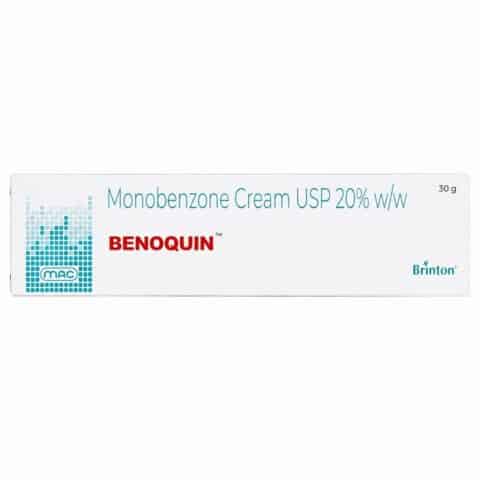
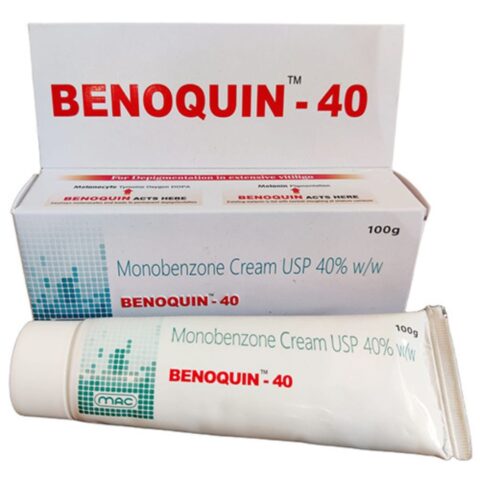
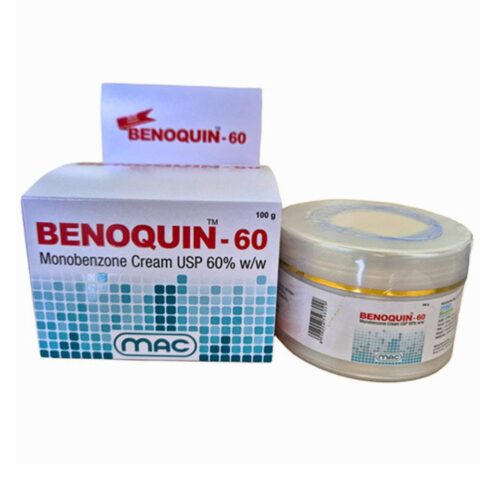
Not automatically. Stronger is faster and rougher, not better. Here is the honest picture of each. You can see every strength listed on the monobenzone page.
Note
Even the clinical literature admits a gap. A case-based review in a dermatology journal points out that there are few recent studies comparing monobenzone concentrations, and an earlier large study found responses to be erratic. If anyone tells you a particular strength is “best”, they are guessing.
What to expect, month by month
Using the US label as the reference, this is what treatment usually looks like. Your doctor may give you a different schedule, and theirs is the one to follow.
Tip
Before you start, ask your doctor what “success” will look like for you and when the two of you will review progress. Agreeing the finish line in advance is the best protection against over-treating.
What it costs you
Colour is not the only thing you give up. You should know the full list before you begin, not after.
- Irritation and dermatitis: burning, redness or eczema-like reactions. The label says to discontinue if irritation, burning or dermatitis occurs.
- Depigmentation away from where you applied it: sometimes irregular, sometimes permanent.
- Permanence: the change is considered irreversible. Spontaneous repigmentation of vitiligo patches can still happen, which can mean further treatment cycles.
- Sun sensitivity: depigmented skin has no pigment defence. The label says to avoid sun exposure or use sunscreen during treatment, and many dermatologists recommend a broad-spectrum SPF 30+ indefinitely afterwards. That is a lifelong habit, not a phase.
- Other reported effects: reviews also list ocular side effects and exogenous ochronosis (a bluish-black discolouration).
- Contact with other people: because the cream can depigment skin it touches, careful handwashing and avoiding prolonged skin-to-skin contact with the treated area, especially with children, is standard advice. Ask your doctor for specifics.
- Unknown long-term cancer risk: the label states that no long-term studies have been done to evaluate carcinogenic potential.
Important
The tannery workers never chose to lose their colour. The cream you are considering uses the same chemical, so the safety rules are not optional extras. They are the difference between a planned result and a repeat of 1939.
The access problem nobody mentions
Here is an uncomfortable fact: the medicine you read about in guidelines is not always the one you can easily get. Drugs.com lists the original US brand, Benoquin, as discontinued in the United States, and at least one US compounding pharmacy says ready-made monobenzone creams are not currently available there. Availability differs from country to country.
That gap is where trouble breeds. Search online and you will find sellers offering “Benoquin” as a whitening cream, with no prescription, sometimes described with the wrong active ingredient altogether. The WHO estimates that around 1 in 10 medical products in low- and middle-income countries is substandard or falsified. With a drug this powerful, a tube of unknown strength can mean permanent patches you never asked for.
So the safe route is narrow. Use a licensed pharmacy, with a valid prescription, and from a seller who will tell you where the product comes from. Check that the strength printed on the tube matches what your doctor prescribed (20%, 40% or 60%), that the packaging is sealed, and that the expiry date and batch number are visible. Be wary of any site that sells it as a “whitening cream” or never asks you for a prescription.
If your dermatologist has prescribed monobenzone, you can see all three strengths here: Monobenzone 20% cream, Monobenzone 40% cream and Monobenzone 60% cream. Everything with this ingredient is listed on the monobenzone page. Not sure which strength your prescription means? Ask your pharmacist before you order.
Five questions to ask before you start
No guideline can answer these for you. Sit with them for a while.
Steroids, calcineurin inhibitors, light therapy, and newer creams where available.
Be honest, even if it is uncomfortable.
Because you will have to.
Patient communities will give you a more honest picture than any product page, including this one.
If the answer is “I don’t know”, wait.
Remember
Three numbers are worth keeping. 50% is roughly the share of the body that has to be affected before this is even on the table. 4 is the number of months after which the label says to stop if there is no result. 5 is the number of years you should picture yourself living with the result before you begin.
How to use it safely
If you and your dermatologist decide to go ahead, these steps protect you most:
- See a dermatologist first. Get the diagnosis confirmed and the extent of your vitiligo measured.
- Ask about a patch test. Trying it on a small area first is common practice, and it reveals sensitivity before you commit.
- Follow the schedule exactly. More cream does not mean faster results, only more irritation.
- Protect your skin from the sun. Sunscreen daily, hats, shade.
- Keep the cream away from other people and from your eyes and mouth. Wash your hands after use.
- Stop and call your doctor if you have blistering, severe burning or an unexpected spread of white patches.
- Keep your follow-ups. Review at the point your doctor chooses, and no later than the label’s four-month mark.
Quick answers to the questions people ask most
Is monobenzone the same as hydroquinone?
No. Hydroquinone is a lightener that generally fades pigment temporarily. Monobenzone, a chemical relative, can destroy melanocytes and cause permanent loss of colour, which is why it must never be used as a hydroquinone substitute.
Is the depigmentation permanent?
It is considered irreversible in the treated skin, because the pigment cells are destroyed. Vitiligo patches can sometimes repigment on their own, so some people need further treatment.
Can I use monobenzone for dark spots or melasma?
No. The label contraindicates it for any condition other than disseminated vitiligo, and using it on dark spots can leave you with permanent white patches.
How long does monobenzone take to work?
Usually one to four months. The US label says to stop if results are not satisfactory after four months.
Is 40% or 60% better than 20%?
Not necessarily. Higher strengths may act faster but they raise the risk of irritation, and published evidence is strongest for 20%. Start with the strength your doctor chooses.
Can monobenzone spread to other people?
It can. Skin contact with treated areas may transfer enough medicine to affect another person’s skin, particularly a child’s. Wash your hands and ask your doctor how to avoid contact.
Does it cause skin cancer?
The label states that no long-term carcinogenicity studies have been done, so the risk is not established. Depigmented skin is more vulnerable to UV damage, which is why sun protection matters.
Is Benoquin still available?
Drugs.com lists the original brand as discontinued in the United States, so availability varies by country. Monobenzone 20%, the strength of the original Benoquin, is listed on this page, alongside the 40% and 60% strengths. Ask your pharmacist what is in stock where you live.
Back to the mirror
Go back to that 7 a.m. mirror for a moment. For some people, monobenzone ends the morning routine, the camouflage and the guessing. For anyone without extensive vitiligo, it is a quick route to permanent, unwanted white skin. What separates those two outcomes is a diagnosis, a conversation with a dermatologist, and patience.
And underneath all of it sits a question no label can answer: whether evening out your skin is a relief or a loss. Only you get to decide that, and you are allowed to take your time.
Key takeaways
Confirm your diagnosis. Exhaust repigmentation options first. Start with the lowest effective strength. Protect your skin from the sun for life. Never use it as a whitening cream. Buy only genuine product from a licensed pharmacy, with a prescription.
Match the strength on your prescription exactly, and ask your pharmacist if anything is unclear.
Monobenzone 20%Monobenzone 40%Monobenzone 60%All monobenzone products
Now it’s your turn. Have you used a depigmenting treatment, or are you weighing one right now? Do you think depigmentation is empowering, or a loss? Tell us in the comments below. Your story could help someone standing at the same mirror.
Sources and further reading
- US FDA, Benoquin Cream 20% (monobenzone) prescribing label, accessdata.fda.gov
- Drugs.com, Benoquin professional monograph, drugs.com/pro/benoquin.html, and monobenzone topical consumer page (discontinued in the US)
- AHFS Drug Information, Monobenzone monograph (American Society of Health-System Pharmacists)
- Oliver EA, Schwartz L, Warren LH, occupational leukoderma from rubber gloves, JAMA (1939 and 1940); follow-up reports in Archives of Dermatology
- Krüger C, Schallreuter KU, “A review of the worldwide prevalence of vitiligo in children/adolescents and adults,” International Journal of Dermatology (2012)
- Rordam OM, Lenouvel EW, Maalo M, “Successful Treatment of Extensive Vitiligo with Monobenzone,” Journal of Clinical and Aesthetic Dermatology
- “Skin-Depigmenting Agent Monobenzone Induces Potent T-Cell Autoimmunity toward Pigmented Cells by Tyrosinase Haptenation and Melanosome Autophagy,” Journal of Investigative Dermatology (2011)
- Monobenzone case report and review, PubMed Central, PMC3533321
- “Depigmentation therapy in vitiligo,” IntechOpen, open access chapter 69638
- Al Qassimi Hospital, “Monobenzone is still the main culprit of chemical vitiligo,” Journal of Pakistan Association of Dermatologists (2023)
- European Medicines Agency, Opzelura (ruxolitinib) product information, ema.europa.eu
- World Health Organization, substandard and falsified medical products fact sheet, who.int