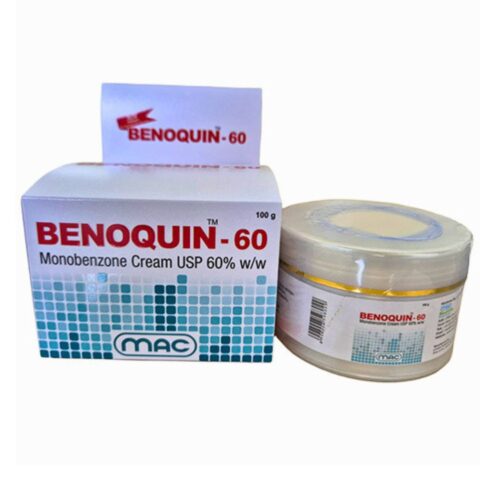
Monobenzone 60% Cream is a high-strength topical depigmenting formulation containing 60% w/w monobenzone. Commercial product listings commonly identify this formulation as Benoquin 60 and list it in a 100g pack. Monobenzone is used medically for permanent depigmentation in people with extensive or disseminated vitiligo; a 60% finished product should not be presented as equivalent to the historical U.S. FDA-approved 20% Benoquin formulation.
📢 Why ads?
We keep our prices low, and ads help cover our website, server, and database costs.
❤️ Please support us by allowing the ads.
You do not need to click on them.
Monobenzone is a potent depigmenting agent used for final depigmentation in extensive vitiligo. The historical U.S. Benoquin 20% labeling specified use in disseminated idiopathic vitiligo involving more than 50% of body surface area. It is not intended as an ordinary cosmetic skin-lightening cream and should not be marketed for freckles, melasma, tanning, or routine pigmentation concerns.
Because monobenzone can produce permanent pigment loss, treatment selection and monitoring should be handled by an appropriately qualified healthcare professional.
The exact mechanism of monobenzone is not fully understood. FDA labeling for Benoquin describes increased melanin loss from melanocytes and notes that monobenzone may cause destruction of melanocytes, resulting in permanent depigmentation.
A 60% formulation contains 600mg of monobenzone per gram of cream based on the stated 60% w/w concentration.
The terms monobenzone and Benoquin refer to the same active ingredient/product family, but the strength matters.
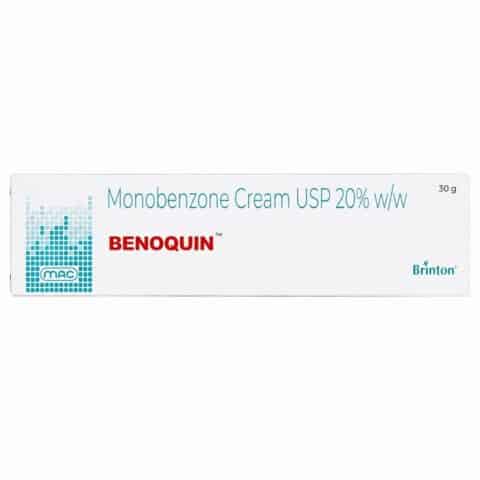
Historical U.S. FDA documentation concerns Benoquin Cream 20%, indicated for final depigmentation in extensive vitiligo. The FDA later noted that this 20% product was no longer being manufactured or distributed and had been de-listed. A commercially listed Benoquin 60 / Monobenzone 60% product is therefore a different-strength finished formulation and should not be described as FDA-approved simply because monobenzone or Benoquin 20% has historical FDA documentation.
Monobenzone is a potent depigmenting agent and can cause irreversible or permanent depigmentation. The historical Benoquin label also describes skin irritation, sensitization, burning, dermatitis, unintended depigmentation at sites away from the application area, and long-term sensitivity to sunlight after depigmentation.
Monobenzone should not be treated as a substitute for hydroquinone and should not be promoted as a routine cosmetic bleaching ingredient. Localized or inappropriate use can produce uneven or unintended pigment loss.
Use should be determined by a qualified healthcare professional, with the product label and applicable local regulations followed.
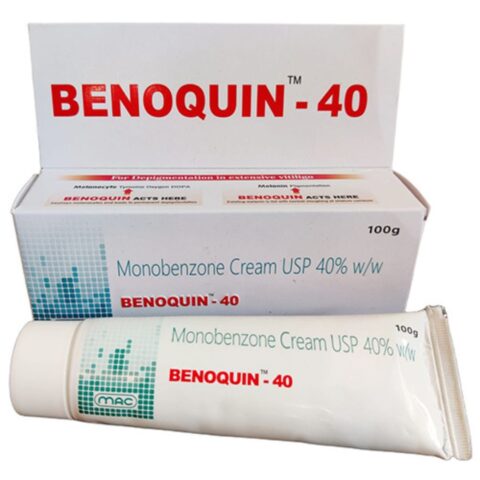
Search demand for monobenzone 60 cream, Benoquin 60 monobenzone cream, monobenzone cream USP 60, monobenzone cream UK, and related product queries shows a clear product-specific search pattern around the 60% formulation. Current commercial listings commonly identify Benoquin 60 as a 60% w/w cream in 100g packaging.
For UK customers, regulatory status should be checked for the specific finished product rather than inferred from the existence of monobenzone as an active substance. MHRA records include monobenzone in active-substance registration records, but an API registration does not by itself establish authorization of a particular 60% finished cream in the UK.
Orders and international delivery should therefore be subject to applicable prescription, importation, and medicines regulations in the destination country.
What is Monobenzone 60% Cream?
Monobenzone 60% Cream is a topical formulation containing 60% w/w monobenzone, commonly marketed in commercial listings as Benoquin 60. Current product listings commonly specify 100g packaging.
What is Benoquin 60 used for?
Monobenzone is used medically for permanent depigmentation in extensive vitiligo. The historical U.S. Benoquin labeling specifically described final depigmentation in extensive/disseminated vitiligo.
Is Monobenzone 60% the same as FDA-approved Benoquin?
No. Historical FDA labeling documented Benoquin Cream 20%. A 60% formulation should not be represented as FDA-approved based on that historical approval.
Is Monobenzone the same as hydroquinone?
No. Monobenzone is the monobenzyl ether of hydroquinone and is a distinct compound with a different clinical role.
Can Monobenzone 60% be used for cosmetic skin whitening?
It should not be promoted for ordinary cosmetic lightening. Monobenzone is a potent depigmenting agent capable of permanent pigment loss and is medically associated with depigmentation in extensive vitiligo.
What pack size is Benoquin 60 commonly sold in?
Current commercial listings commonly specify a 100g jar, tube, or container, although packaging can vary between suppliers and manufacturers.
Is Monobenzone 60% available in the UK?
Commercial availability and legal supply depend on the specific finished product and applicable UK medicines requirements. Monobenzone appears in MHRA active-substance registration records, but that does not by itself confirm authorization of a particular 60% finished cream.
Can monobenzone cause permanent depigmentation?
Yes. Permanent depigmentation is a known effect of monobenzone, and unintended or irregular depigmentation can also occur.
Last Updated: September 22, 2026 | Medical Review: Review by a licensed healthcare professional recommended before publication
Medical Disclaimer: This information is provided for educational purposes only and is not a substitute for professional medical advice, diagnosis, or treatment. Monobenzone is a potent depigmenting agent and should only be used under appropriate medical supervision. Always consult a qualified healthcare professional before starting or changing any prescription or specialist dermatological treatment.
Orders ship from our India Head Office within 1–2 business days of confirmation. We include full customs documentation — HS codes, certificates of origin, and pharmaceutical export permits.
Estimated delivery: 3–7 business days to UK. 7–10 business days to UAE, Saudi Arabia and Gulf countries. 10–15 days for USA and Asian countries.
All packages arrive in plain, unmarked brown boxes. No pharmacy name or medication details on the outside.
Only logged in customers who have purchased this product may leave a review.

Reviews
There are no reviews yet.