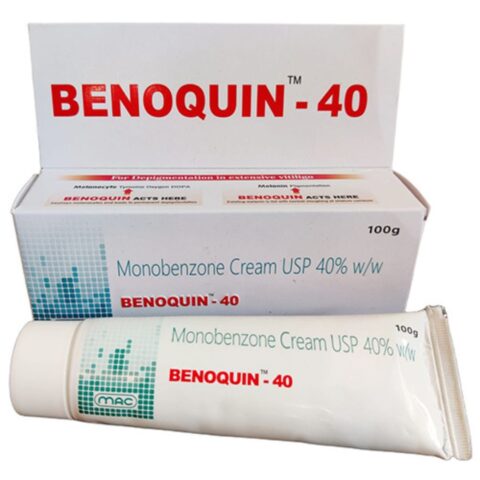
Monobenzone 40% Cream, commonly marketed internationally as Benoquin 40, is a potent topical depigmenting formulation containing monobenzone 40% w/w. It is intended for medical depigmentation rather than cosmetic skin whitening.
Monobenzone is the monobenzyl ether of hydroquinone and acts differently from ordinary cosmetic skin-lightening agents. It can produce irreversible loss of pigmentation, which is why monobenzone products require careful medical supervision and are generally associated with extensive vitiligo rather than routine hyperpigmentation treatment.
Important U.S. distinction: Historical FDA-approved Benoquin was 20% monobenzone, not 40%. The 40% formulations marketed internationally should not be represented as an FDA-approved U.S. 40% product.
📢 Why ads?
We keep our prices low, and ads help cover our website, server, and database costs.
❤️ Please support us by allowing the ads.
You do not need to click on them.
Monobenzone is used medically for permanent depigmentation of normal skin surrounding areas affected by extensive vitiligo in appropriately selected patients.
Historical FDA labeling for Benoquin 20% specifies its use for final depigmentation in patients with disseminated idiopathic vitiligo affecting more than 50% of body surface area.
The purpose is to reduce remaining normal pigmentation so that extensive areas of skin have a more uniform appearance.
Monobenzone is not intended as a routine treatment for:
Monobenzone is a potent depigmenting agent that affects melanocytes, the pigment-producing cells responsible for melanin production.
Its precise mechanism is not completely understood, but topical monobenzone can increase melanin elimination and may result in destruction or loss of melanocytes. Because melanocyte loss can be permanent, depigmentation produced by monobenzone may also be permanent.
The FDA’s historical Benoquin labeling specifically notes that monobenzone is capable of producing irreversible depigmentation.
This distinction is important for international SEO and product accuracy.
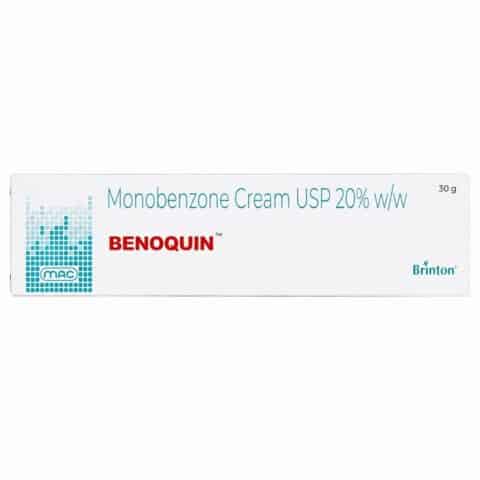
Benoquin 20% is the historical U.S. FDA-approved formulation.
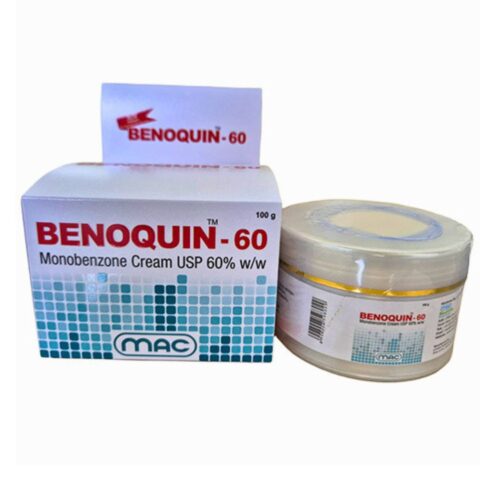
Benoquin 40% / Monobenzone 40% Cream refers to a higher-strength international formulation marketed under the Benoquin name by certain manufacturers.
They are not interchangeable by label strength, and a 40% product should not be represented as the FDA-approved U.S. Benoquin 20% formulation.
Monobenzone and hydroquinone are chemically related but have very different clinical purposes.
Monobenzone is a strong depigmenting agent associated with permanent melanocyte loss.
Hydroquinone is generally used as a topical treatment to reduce melanin production in conditions involving localized hyperpigmentation and does not have the same intended permanent depigmentation role.
Monobenzone should therefore not be treated as simply a stronger version of hydroquinone.
No.
Monobenzone is not an ordinary cosmetic bleaching ingredient. Its purpose in medical treatment is permanent depigmentation in appropriately selected patients with extensive vitiligo.
Using high-strength monobenzone on normal skin purely for cosmetic lightening can result in unpredictable and potentially permanent pigment loss.
The historical FDA-approved Benoquin label identifies Benoquin Cream 20% (monobenzone) as a prescription depigmenting medicine indicated for final depigmentation in extensive vitiligo.
FDA documentation also states that the product was approved under NDA 008173. Later FDA materials note that the product was no longer manufactured or distributed and had been de-listed.
Therefore:
Monobenzone is substantially more potent than ordinary cosmetic depigmenting products.
Potential concerns include:
The historical FDA label specifically warns that Benoquin is not a cosmetic skin bleach and should not be used for conditions other than disseminated vitiligo.
Loss of melanin substantially reduces the skin’s natural pigment protection.
Patients undergoing medical depigmentation therefore require appropriate protection from ultraviolet exposure and should follow the advice of their dermatologist or treating healthcare professional.
Sun exposure can also influence the visual appearance and durability of depigmented skin.
Monobenzone should not be used casually or as a general-purpose whitening product.
It is particularly inappropriate for people seeking treatment for:
People with a history of sensitivity to monobenzone or other formulation ingredients should avoid the product unless a specialist determines otherwise.
For an international Monobenzone 40% / Benoquin 40 product, verify:
Do not assume that products labelled Benoquin 40, Monobenzone 40, or Monobenzone Cream USP 40% are identical simply because the active ingredient and concentration appear similar.
Search demand for this product includes Monobenzone 40% Cream USA, Benoquin 40 Cream USA, Monobenzone Cream USP 40%, Benoquin 40 Cream 100g, Monobenzone Cream UK, Monobenzone 40% Australia, Benoquin Cream UAE, Monobenzone 40 Germany, Monobenzone 40 Korea and Monobenzone 40 France.
Because the 40% formulation is not the historical FDA-approved U.S. Benoquin strength, international product listings should clearly distinguish 40% monobenzone formulations from the former U.S. Benoquin 20% product.
What is Monobenzone 40% Cream?
Monobenzone 40% Cream is a high-strength topical depigmenting formulation containing 40% monobenzone by weight.
What is Benoquin 40?
Benoquin 40 is an international product name used for certain 40% monobenzone cream formulations. The exact manufacturer and packaging should be checked for each product.
Is Benoquin 40 the same as U.S. Benoquin 20%?
No. The strength is different. Historical U.S. FDA-approved Benoquin was 20% monobenzone, while Benoquin 40 contains 40% monobenzone.
Is Monobenzone 40% FDA approved in the USA?
The historical FDA-approved Benoquin formulation is 20%, not 40%. A 40% international formulation should not be represented as FDA-approved U.S. Benoquin.
What is Benoquin used for?
Monobenzone is used for final depigmentation in selected patients with extensive vitiligo. Historical FDA labeling specifically limits Benoquin use to disseminated vitiligo.
Does Monobenzone permanently lighten skin?
Monobenzone can cause permanent depigmentation because it can result in melanocyte loss. The effect can be unpredictable and is not comparable to temporary cosmetic skin lightening.
Is Benoquin the same as hydroquinone?
No. Monobenzone and hydroquinone are different compounds with different clinical purposes. Monobenzone is used for permanent depigmentation, whereas hydroquinone is generally used for localized hyperpigmentation.
Can Benoquin 40 be used for cosmetic skin whitening?
No. Monobenzone is not intended as a cosmetic whitening cream, and inappropriate use can cause irreversible pigment loss.
Is Benoquin 40 available internationally?
40% formulations are marketed internationally, but availability, legality, prescription status and import requirements depend on the destination country.
What size is Benoquin 40 Cream?
Current international listings commonly show 100g packaging for 40% monobenzone cream.
Last Updated: September 22, 2026
Medical Disclaimer: This information is provided for educational and product-information purposes only and is not a substitute for professional medical advice, diagnosis or treatment. Monobenzone is a potent depigmenting medicine capable of causing permanent pigment loss and should only be used under appropriate medical supervision. It is not intended for routine cosmetic skin whitening.
Orders ship from our India Head Office within 1–2 business days of confirmation. We include full customs documentation — HS codes, certificates of origin, and pharmaceutical export permits.
Estimated delivery: 3–7 business days to UK. 7–10 business days to UAE, Saudi Arabia and Gulf countries. 10–15 days for USA and Asian countries.
All packages arrive in plain, unmarked brown boxes. No pharmacy name or medication details on the outside.
Only logged in customers who have purchased this product may leave a review.

Reviews
There are no reviews yet.