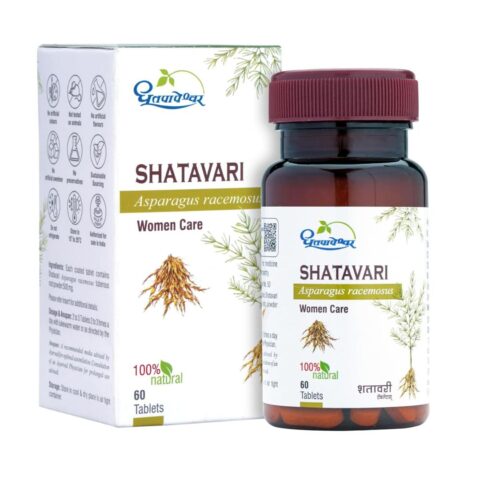
Shatavari Tablet is an Ayurvedic herbal supplement containing Shatavari (Asparagus racemosus), a botanical traditionally used in Indian Ayurvedic practice. Shatavari root contains steroidal saponins and other naturally occurring plant compounds and is commonly used in traditional wellness products, particularly those marketed for women’s health, reproductive wellness and lactation support.
The exact composition and strength of Shatavari Tablets vary by manufacturer, extract type and standardization. The product label should therefore be checked for the amount of Shatavari root or extract, extract ratio and any additional ingredients.
Shatavari has a long history of traditional use in Ayurveda and is especially associated with women’s health and reproductive wellness.
Modern Shatavari products are commonly marketed for:
These uses should not be interpreted as established treatments for infertility, hormonal disorders, menopause or other medical conditions.
Shatavari has traditionally been used in India as a galactagogue, meaning an herbal product intended to support breast milk production. Modern research has investigated this use, but evidence remains limited and varies between preparations.
Recent controlled studies have reported increased milk output or improved lactation-related outcomes with specific Shatavari preparations, while the U.S. National Library of Medicine’s LactMed database notes that the overall evidence remains mixed and that safety during lactation has not been rigorously established across products.
Shatavari should therefore not replace professional assessment of low milk supply or evidence-based breastfeeding support.
Shatavari contains several naturally occurring constituents, including steroidal saponins such as shatavarins, flavonoids and other phytochemicals.
Researchers have investigated possible effects involving hormonal signalling, antioxidant activity and other biological pathways. However, the mechanisms and clinical relevance of these effects depend on the specific extract and cannot automatically be applied to every Shatavari Tablet.
Shatavari is particularly prominent in traditional Ayurvedic women’s-health formulations. It is commonly associated with:
Several recent clinical studies have investigated standardized Shatavari root extracts in perimenopausal and menopausal women, but results from individual formulations should not be generalized to every Shatavari product.
Although Shatavari is strongly associated with women’s wellness, Shatavari products are also marketed for general vitality and men’s wellness.
Traditional use and modern supplement marketing should not be confused with established clinical treatment. Evidence for specific male-health outcomes remains much less established than the traditional reputation of the herb.
Shatavari Tablets may contain root powder or a concentrated root extract.
Root powder contains the naturally occurring constituents present in the dried root, while an extract is processed to concentrate selected compounds.
Consequently, a tablet containing 500 mg of root powder is not necessarily equivalent to a 500 mg tablet containing a concentrated extract.
When comparing products, check:
Shatavari is a botanical supplement, and safety can vary with the formulation, extraction method and individual health status.
People who are pregnant, breastfeeding, undergoing fertility treatment, taking prescription medicines or managing a chronic medical condition should consult a qualified healthcare professional before using Shatavari.
Particular caution may be appropriate for people with conditions or medicines affected by hormonal activity because Shatavari contains steroidal saponins and compounds with potential phytoestrogenic activity.
Stop use and seek medical advice if significant or persistent adverse symptoms occur.
Herbal supplements can also vary in actual ingredient content, so reputable sourcing and appropriate quality testing are important.
For a high-quality Shatavari Tablet, look for:
Products using the same “Shatavari” name may have substantially different formulations.
Shatavari Tablets are sold through Ayurvedic, herbal and dietary-supplement markets in many countries. Regulatory classification, permitted health claims and import requirements vary by destination.
Customers searching for Shatavari Tablet UK, Shatavari Tablets UK, Shatavari supplement UK, Buy Shatavari Tablets UK, Asparagus racemosus tablets, Shatavari Tablet Australia, Shatavari Tablets Thailand, Shatavari UAE, Shatavari Tablets USA and Shatavari Korea should verify the exact formulation, botanical identity, manufacturer and local requirements before purchasing.
What is Shatavari Tablet?
Shatavari Tablet is a herbal supplement containing the root or root extract of Asparagus racemosus, a plant traditionally used in Ayurveda.
What is Shatavari used for?
Shatavari is traditionally used for general wellness and is particularly associated with women’s wellness, reproductive health and lactation support.
What is the botanical name of Shatavari?
The botanical name is Asparagus racemosus.
Is Shatavari the same as asparagus used as a vegetable?
No. Shatavari is Asparagus racemosus, commonly called wild asparagus, and is different from the edible vegetable species Asparagus officinalis.
Can Shatavari support breast milk production?
Shatavari has traditionally been used for lactation support. Some controlled studies have reported improved milk production with specific Shatavari preparations, but overall evidence is still limited and mixed.
Can men take Shatavari Tablets?
Shatavari is traditionally associated with women’s wellness, but products are also marketed for general men’s wellness. Suitability depends on the individual and the exact formulation.
Is Shatavari the same as Ashwagandha?
No. Shatavari is Asparagus racemosus, while Ashwagandha is Withania somnifera. They are different botanical ingredients.
Is Shatavari a medicine?
Shatavari products are generally marketed as herbal, Ayurvedic or dietary supplements, although their regulatory classification varies by country.
Are all Shatavari Tablets the same?
No. Products may contain root powder, concentrated extract or different standardized preparations, so strength and composition can vary considerably.
Is Shatavari safe during pregnancy or breastfeeding?
Safety cannot be assumed for every formulation. Anyone who is pregnant or breastfeeding should discuss Shatavari use with an appropriate healthcare professional before taking it.
Last Updated: September 19, 2026
Medical Disclaimer: This information is provided for educational and product-information purposes only and is not a substitute for professional medical advice, diagnosis or treatment. Always check the product label and consult a qualified healthcare professional before using herbal supplements, particularly during pregnancy, breastfeeding, fertility treatment or when taking prescription medicines.
Orders ship from our India Head Office within 1–2 business days of confirmation. We include full customs documentation — HS codes, certificates of origin, and pharmaceutical export permits.
Estimated delivery: 3–7 business days to UK. 7–10 business days to UAE, Saudi Arabia and Gulf countries. 10–15 days for USA and Asian countries.
All packages arrive in plain, unmarked brown boxes. No pharmacy name or medication details on the outside.
Only logged in customers who have purchased this product may leave a review.


Reviews
There are no reviews yet.