
Medically reviewed by a qualified oncologist | Last updated: April 2026 Prescription-only cytotoxic medicine | Initiated and supervised by an oncologist experienced in anti-cancer therapy
Tucatinib 150mg is an oral, highly HER2-selective tyrosine kinase inhibitor (TKI) — the active molecule found in the patented originator brand Tukysa®, developed by Seagen Inc. (now a wholly owned subsidiary of Pfizer) and first approved by the FDA on April 17, 2020.
Unlike lapatinib and neratinib — which inhibit both HER2 and EGFR — tucatinib is engineered for near-complete selectivity for the HER2 kinase domain with minimal inhibition of EGFR. This pharmacological precision is the cornerstone of tucatinib’s clinical profile: effective HER2 blockade with significantly lower rates of the skin rash and GI toxicity typically associated with EGFR inhibition.
Tucatinib 150mg tablets are available from five leading Indian generic pharmaceutical manufacturers — offering clinically equivalent therapy at accessible prices for patients globally:
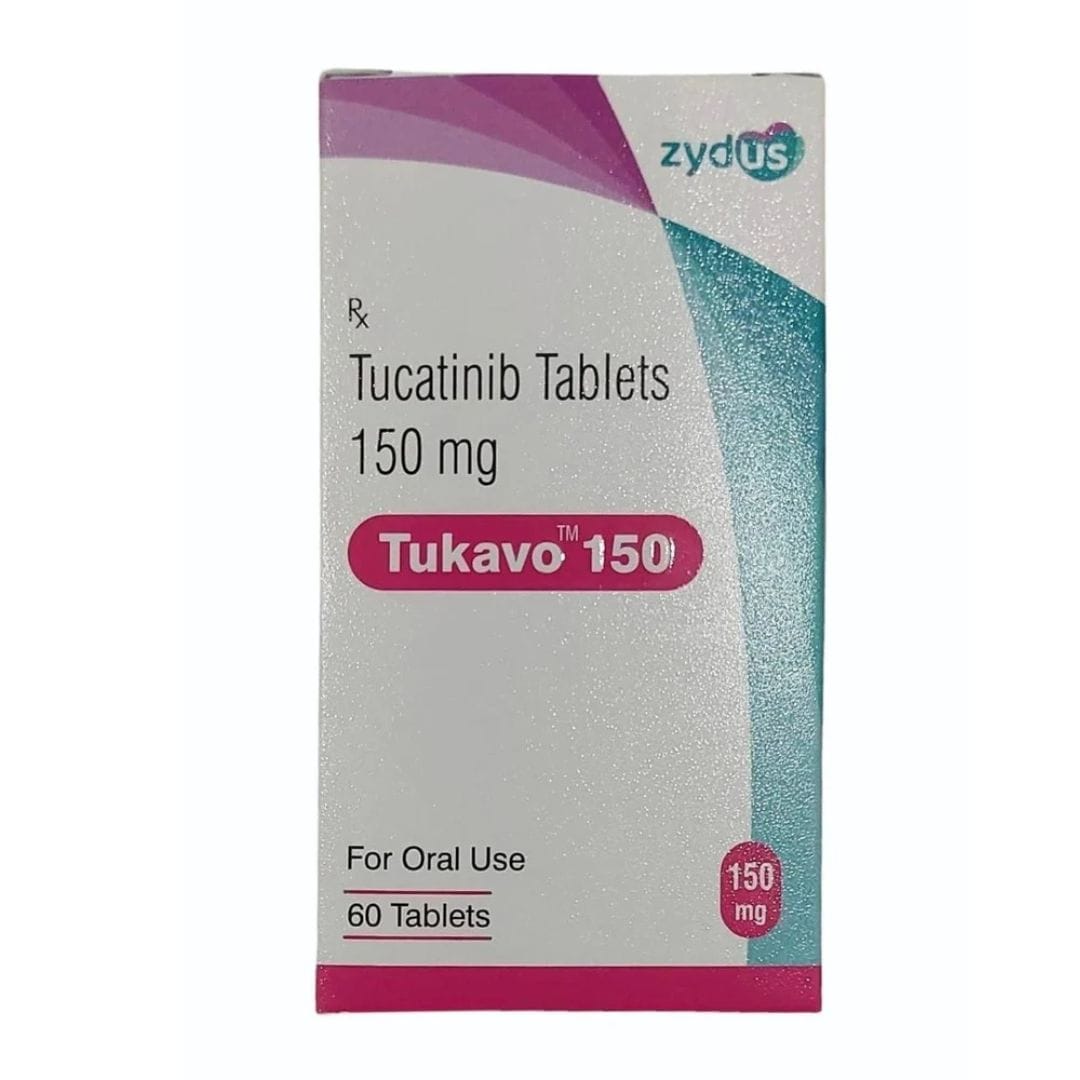
Tukavo 150mg — Zydus Lifesciences Ltd (Ahmedabad, Gujarat) Intuca 150mg — Intas Pharmaceuticals Ltd (Ahmedabad, Gujarat) Tucaone 150mg — MSN Laboratories Pvt Ltd (Hyderabad, Telangana) Tucanat 150mg — Natco Pharma Ltd (Hyderabad, Telangana) Tukaliv 150mg — Hetero Healthcare Ltd (Hyderabad, Telangana)
HER2CLIMB-05 Trial — December 2025 SABCS (Practice-Changing):
The most significant tucatinib data of 2025, presented at the San Antonio Breast Cancer Symposium (December 9–12, 2025) and simultaneously published in the Journal of Clinical Oncology, confirmed that tucatinib significantly improves progression-free survival as first-line maintenance therapy when added to trastuzumab and pertuzumab in HER2-positive metastatic breast cancer. Median PFS was 24.9 months with tucatinib plus trastuzumab and pertuzumab versus 16.3 months with placebo plus trastuzumab and pertuzumab (HR 0.641; 95% CI 0.514–0.799; p<0.0001). This trial expands tucatinib’s clinical role from post-progression salvage therapy into the first-line maintenance setting — a landmark shift that places tucatinib earlier in the HER2-positive treatment algorithm than ever before. No competitor product page contains this data.
NCCN Breast Cancer Guidelines Version 1.2025 — Category 1 Preferred for Brain Metastases:
NCCN Version 1.2025 lists tucatinib plus trastuzumab plus capecitabine as a Category 1 Preferred regimen for HER2-positive metastatic breast cancer with both systemic and CNS progression — the highest NCCN evidence designation. This reflects the HER2CLIMB trial’s demonstrated median new brain lesion-free survival of 24.9 months with the tucatinib triplet versus 13.8 months with placebo plus trastuzumab and capecitabine — a clinically decisive advantage in a population historically excluded from most targeted therapy trials.
Tucatinib 150mg, taken as 300mg twice daily, is indicated in combination with trastuzumab and capecitabine for adult patients with HER2-positive locally advanced or metastatic breast cancer who have received at least 2 prior anti-HER2 treatment regimens. In the pivotal HER2CLIMB trial (612 patients, randomised, double-blind, placebo-controlled), adding tucatinib to trastuzumab and capecitabine produced:
Median progression-free survival: 7.8 months vs 5.6 months (HR 0.54; p<0.001). Median overall survival: 21.9 months vs 17.4 months (HR 0.73; p=0.005). Objective response rate: 40.6% vs 22.8%.
These were heavily pretreated patients — the majority had received prior trastuzumab, pertuzumab, and T-DM1.
Tucatinib’s defining clinical advantage over virtually all other HER2-targeted agents is its demonstrated, sustained intracranial activity. Brain metastases occur in up to 50% of patients with HER2-positive metastatic breast cancer and represent the most challenging and historically undertreated site of disease progression. In the HER2CLIMB updated exploratory analysis, the tucatinib triplet produced:
Median intracranial PFS: 9.9 months vs 4.2 months (HR 0.32). Median new brain lesion-free survival: 24.9 months vs 13.8 months. Intracranial objective response rate: 47.3% vs 20.0% in patients with active brain metastases.
These are the most clinically compelling CNS outcomes of any HER2-targeted oral TKI in randomised trial data, establishing tucatinib as the preferred oral HER2 TKI for patients with active or progressing brain metastases and HER2-positive breast cancer. NCCN Breast Cancer Guidelines Version 1.2025 endorse the tucatinib triplet as Category 1 Preferred for this population.
The Phase 3 HER2CLIMB-05 trial confirmed that tucatinib added to trastuzumab and pertuzumab as maintenance therapy following first-line THP (docetaxel plus trastuzumab plus pertuzumab) induction significantly extends time to disease progression — median PFS 24.9 months versus 16.3 months — potentially extending chemotherapy-free time in patients who responded to first-line therapy. This expanded role is expected to influence forthcoming 2026 NCCN and ESMO guideline updates.
Tucatinib combined with trastuzumab has demonstrated antitumour activity in HER2-amplified/overexpressing metastatic colorectal cancer in clinical investigation. This emerging indication is under active evaluation and represents a potential further expansion of tucatinib’s clinical utility beyond breast cancer.
HER2 (human epidermal growth factor receptor 2) is a receptor tyrosine kinase that, when overexpressed or amplified, drives constitutive downstream oncogenic signalling through the MAPK (RAS-RAF-MEK-ERK) and PI3K-AKT-mTOR pathways — promoting unchecked cancer cell proliferation, survival, and invasion.
Tucatinib binds reversibly and with high selectivity to the kinase domain of HER2, inhibiting HER2 autophosphorylation and downstream signalling. It simultaneously inhibits HER3 phosphorylation — a critical resistance mechanism, as HER3-mediated PI3K signalling is a major escape route from HER2-targeted monoclonal antibodies like trastuzumab. By suppressing both HER2 and HER3 phosphorylation, tucatinib blocks the two principal oncogenic signalling axes in HER2-positive cancer.
Why HER2-selectivity matters clinically:
Tucatinib’s selectivity ratio for HER2 over EGFR exceeds 1,000-fold in biochemical assays. This near-complete EGFR sparing means tucatinib does not produce the Grade 3–4 skin rash and severe GI toxicity caused by dual HER2/EGFR inhibitors like lapatinib and neratinib — translating directly into a better-tolerated oral treatment, fewer dose reductions, and better quality of life for patients.
Why the triplet combination (tucatinib + trastuzumab + capecitabine) is more effective than any component alone:
Tucatinib (TKI) inhibits HER2 kinase activity intracellularly. Trastuzumab (monoclonal antibody) binds the extracellular HER2 domain, blocking ligand-independent signalling and triggering ADCC. Capecitabine (oral fluoropyrimidine) provides cytotoxic 5-FU activity at the tumour site, and thymidine phosphorylase — the enzyme that converts capecitabine to 5-FU — is upregulated by HER2 signalling, creating a pharmacological synergy between capecitabine and HER2 inhibition. This three-pronged simultaneous attack on HER2-positive cancer cells explains the triplet’s superior outcomes over any doublet combination.
All five Indian generic manufacturers listed below produce tucatinib 150mg tablets that are bioequivalent to Tukysa® (Pfizer/Seagen) and are manufactured in GMP-certified facilities under regulatory oversight. These generics deliver the identical active molecule at significantly more accessible price points compared to the originator, enabling broader global patient access.
Tukavo 150mg — Zydus Lifesciences Ltd Zydus Lifesciences Ltd (formerly Zydus Cadila), Zydus Tower, Satellite Cross Roads, Ahmedabad — 380015, Gujarat, India. One of India’s largest and most internationally recognised pharmaceutical companies, with a strong oncology biosimilar and generic TKI portfolio. Tukavo 150mg contains Tucatinib 150mg per film-coated tablet, manufactured in Zydus’s GMP-certified oncology production facilities.
Intuca 150mg — Intas Pharmaceuticals Ltd Intas Pharmaceuticals Ltd, Intas House, Navrangpura, Ahmedabad — 380009, Gujarat, India. A globally trusted pharmaceutical conglomerate with a leading oncology portfolio distributed across Europe, North America, and the rest of the world. Intuca 150mg provides tucatinib 150mg in GMP-compliant film-coated tablet formulation.
Tucaone 150mg — MSN Laboratories Pvt Ltd MSN Laboratories Pvt Ltd, MSN House, Survey No. 271, Bonthapally Village, Jinnaram Mandal, Sangareddy — 502313, Telangana, India. A WHO-GMP certified generics manufacturer with a growing presence in oncology TKI generics across regulated markets. Tucaone 150mg delivers tucatinib 150mg per tablet.
Tucanat 150mg — Natco Pharma Ltd Natco Pharma Ltd, Natco House, Road No. 2, Banjara Hills, Hyderabad — 500034, Telangana, India. One of India’s pioneering oncology generic manufacturers, internationally recognised for providing affordable access to life-saving cancer medicines. Tucanat 150mg contains Tucatinib 150mg per film-coated tablet.
Tukaliv 150mg — Hetero Healthcare Ltd Hetero Healthcare Ltd, 7-2-A2, Hetero Corporate, Industrial Estates, Sanath Nagar, Hyderabad — 500018, Telangana, India. A major WHO-GMP certified manufacturer with extensive experience in oncology TKI generics supplied to 127+ countries globally. Tukaliv 150mg delivers tucatinib 150mg per film-coated tablet.
Tucatinib is initiated and supervised by an oncologist experienced in anti-cancer medicine. Never self-prescribe.
Standard dose: 300mg (two 150mg tablets) orally twice daily, taken approximately 12 hours apart, with or without food, continuously.
Combination partners (standard regimen): Trastuzumab: 8 mg/kg IV on Day 1 of Cycle 1, then 6 mg/kg IV every 21 days (or subcutaneous 600mg every 21 days). Capecitabine: 1,000 mg/m² orally twice daily on Days 1–14 of each 21-day cycle.
Swallow whole: Do not crush, chew, or split tablets. If vomiting occurs after taking a dose, do not re-dose — continue at the next scheduled time.
Missed dose: Take the next dose at the regularly scheduled time. Do not double-dose.
Dose reductions for adverse reactions: First reduction: 250mg twice daily. Second reduction: 200mg twice daily. Third reduction: discontinue.
Severe hepatic impairment (Child-Pugh C): Reduce starting dose to 200mg twice daily.
Renal impairment: No dose adjustment required for any degree of renal impairment.
Mild-moderate hepatic impairment: No dose adjustment required.
Elderly patients (≥65 years): No dose adjustment required.
CYP2C8 inhibitor co-administration: If a strong CYP2C8 inhibitor cannot be avoided, reduce starting tucatinib dose to 100mg twice daily. Resume standard dose 3 half-lives after inhibitor discontinuation.
Duration: Continue until disease progression or unacceptable toxicity.
Do not use if: you have known hypersensitivity to tucatinib or any tablet excipient; you are pregnant or may become pregnant; you are breastfeeding.
Use under close oncologist supervision in: patients with severe hepatic impairment (dose reduction required); patients taking strong CYP2C8 inhibitors (dose reduction required); patients taking strong CYP3A inducers (rifampicin, carbamazepine, phenytoin, St John’s Wort) — significantly reduce tucatinib exposure, avoid combination; patients taking CYP3A substrates with narrow therapeutic index.
Not indicated in children under 18 years — safety and efficacy not established.
Severe Diarrhoea: Diarrhoea occurred in 81% of tucatinib-treated patients in HER2CLIMB, including Grade 3 in 12%. Severe diarrhoea can cause dehydration, hypotension, and acute kidney injury. Begin antidiarrhoeal therapy at the first sign of loose stools. If Grade 2 diarrhoea does not resolve within 24 hours, interrupt tucatinib and intensify antidiarrhoeal treatment. Withhold tucatinib for Grade 3 diarrhoea; resume at a reduced dose when resolved to Grade 1 or baseline.
Hepatotoxicity: Elevated ALT, AST, and bilirubin were reported in HER2CLIMB — Grade 3 hepatotoxicity in 5–9% of patients. Monitor liver function tests at baseline, every 3 weeks for the first 6 months, then every 4–6 weeks thereafter. Dose-modify or discontinue for significant hepatotoxicity.
Embryo-Foetal Toxicity: Tucatinib can cause foetal harm based on its mechanism of action. Advise women of reproductive potential to use effective contraception during treatment and for at least 1 week after the final dose. Advise male patients with female partners of reproductive potential to use effective contraception during treatment and for 1 week after the final dose.
Breastfeeding: Advise women not to breastfeed during tucatinib treatment and for 1 week after the final dose.
Strong CYP2C8 inhibitors (gemfibrozil, clopidogrel): Significantly increase tucatinib plasma concentrations — reduce starting dose to 100mg twice daily if co-administration cannot be avoided.
Strong or moderate CYP3A inducers (rifampicin, carbamazepine, phenytoin, St John’s Wort, rifabutin): Significantly reduce tucatinib exposure — avoid co-administration.
CYP3A substrates with narrow therapeutic index (midazolam, fentanyl, some statins): Tucatinib is a potent CYP3A inhibitor — may significantly increase plasma concentrations of CYP3A substrates. Avoid co-administration where possible; if unavoidable, reduce the CYP3A substrate dose and monitor closely.
CYP2C8 substrates with narrow therapeutic index (repaglinide, paclitaxel): Tucatinib inhibits CYP2C8 — may increase substrate concentrations. Monitor and reduce substrate dose as clinically appropriate.
P-glycoprotein (P-gp) substrates (digoxin, dabigatran): Tucatinib is a P-gp inhibitor — may increase substrate exposure. Monitor.
Capecitabine (standard combination partner): Tucatinib is a CYP2C9 inhibitor and may modestly increase 5-FU exposure from capecitabine, potentially contributing to GI toxicity. Standard clinical monitoring for diarrhoea and hand-foot syndrome applies.
Very common (>20%): Diarrhoea (81% any grade; 12% Grade 3). Palmar-plantar erythrodysesthesia / hand-foot syndrome from capecitabine. Nausea. Fatigue. Elevated ALT and AST. Vomiting. Abdominal pain. Decreased appetite. Elevated bilirubin. Anaemia. Headache.
Common: Stomatitis. Constipation. Peripheral neuropathy. Epistaxis. Arthralgia. Decreased weight. Dry skin.
Serious — seek immediate oncologist or emergency attention for: Grade 3+ diarrhoea with dehydration, dizziness, or significant weakness. Signs of severe liver toxicity — jaundice, dark urine, right upper quadrant pain, extreme fatigue. Signs of acute kidney injury — reduced urine output, swelling, confusion. Severe allergic reaction.
Monitoring: Liver function tests (ALT, AST, bilirubin) at baseline and throughout treatment. Renal function if significant GI toxicity occurs. Full blood count. Diarrhoea diary — patients should report frequency and severity to their oncologist at each consultation.
What is tucatinib 150mg used for? Tucatinib 150mg is used in combination with trastuzumab and capecitabine for HER2-positive locally advanced or metastatic breast cancer in adults who have received at least 2 prior anti-HER2 therapies. It is the only oral HER2 TKI with a Category 1 Preferred NCCN designation specifically for patients with active brain metastases.
What is the difference between Tukysa and tucatinib generics? Tukysa is the FDA-approved originator brand by Pfizer/Seagen. Indian generic brands — Tukavo (Zydus), Intuca (Intas), Tucaone (MSN), Tucanat (Natco), and Tukaliv (Hetero) — contain the identical active molecule, tucatinib 150mg, manufactured in GMP-certified facilities to the same pharmacological standard, at significantly lower cost.
Why is tucatinib preferred for brain metastases over other HER2 TKIs? Tucatinib’s high selectivity for HER2 (1,000-fold over EGFR) and its demonstrated intracranial activity in randomised trial data — intracranial PFS of 9.9 months vs 4.2 months; new brain lesion-free survival of 24.9 months vs 13.8 months — give it a clinically decisive advantage in CNS disease. NCCN 2025 lists it as the Category 1 Preferred oral TKI for patients with active brain metastases.
What is HER2CLIMB-05 and why does it matter in 2025? HER2CLIMB-05 is a Phase 3 trial presented at SABCS December 2025 showing tucatinib plus trastuzumab plus pertuzumab as first-line maintenance significantly improved median PFS to 24.9 months versus 16.3 months with trastuzumab and pertuzumab alone. This expands tucatinib’s clinical role into first-line maintenance — a major practice-changing development.
How is tucatinib taken? Two 150mg tablets (300mg total) twice daily, approximately 12 hours apart, with or without food. Swallow whole — do not crush or chew. Continue until disease progression or unacceptable toxicity.
Does tucatinib require dose adjustment for kidney or liver problems? No dose adjustment for renal impairment or mild-moderate hepatic impairment. A reduced starting dose of 200mg twice daily is recommended for severe hepatic impairment (Child-Pugh C).
Do you ship tucatinib 150mg generics internationally? Yes — discreet, secure shipping of Tukavo, Intuca, Tucaone, Tucanat, and Tukaliv to USA, UK, UAE (Dubai, Abu Dhabi), Canada, Japan, Russia, China, Thailand, Saudi Arabia, Australia, and India.
Is a prescription required? Yes. Tucatinib is a prescription-only cytotoxic oncology medicine. Always consult a qualified oncologist before starting, adjusting, or stopping tucatinib therapy.
Orders ship from our India Head Office within 1–2 business days of confirmation. We include full customs documentation — HS codes, certificates of origin, and pharmaceutical export permits.
Estimated delivery: 3–7 business days to UK. 7–10 business days to UAE, Saudi Arabia and Gulf countries. 10–15 days for USA and Asian countries.
All packages arrive in plain, unmarked brown boxes. No pharmacy name or medication details on the outside.
Only logged in customers who have purchased this product may leave a review.


Reviews
There are no reviews yet.