Medically reviewed by a registered clinical pharmacist specialising in nephrology and cardiometabolic medicine. Content sourced from the FDA prescribing information for Finerenone (Kerendia, 2021 & updated 2025), FIDELIO-DKD and FIGARO-DKD trial publications in the New England Journal of Medicine, KDIGO CKD Clinical Practice Guidelines 2024, and ADA Standards of Care in Diabetes 2025. Last updated: June 2026.
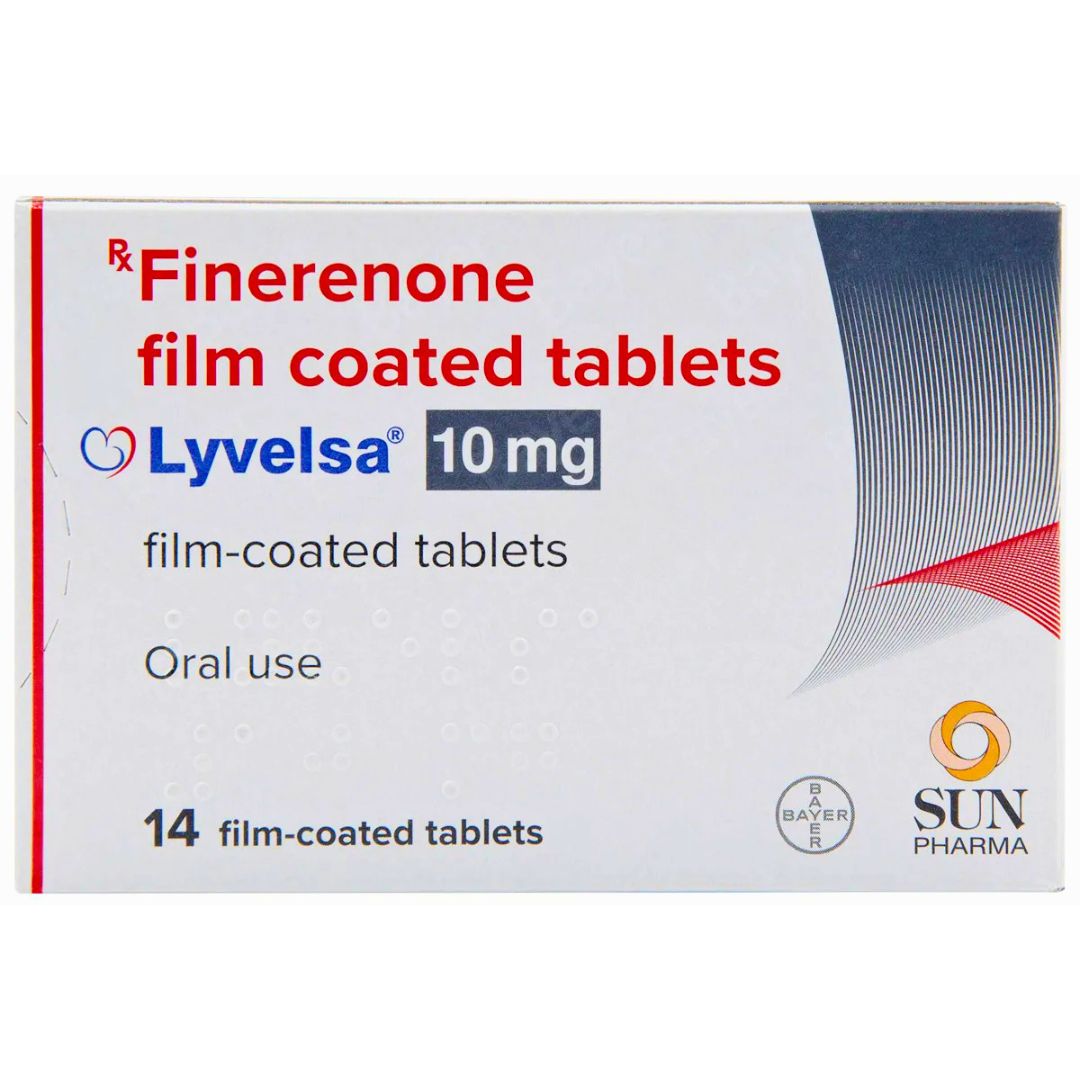
Lyvelsa 10mg is a generic Finerenone tablet manufactured by Sun Pharma — the same active molecule as brand-name Kerendia (Bayer). Finerenone is a nonsteroidal, selective mineralocorticoid receptor antagonist (MRA) prescribed to adults with chronic kidney disease (CKD) associated with Type 2 diabetes (T2D) to reduce the risk of kidney failure, sustained eGFR decline, cardiovascular death, heart attack, and hospitalisation for heart failure. Clinically proven in the landmark FIDELIO-DKD and FIGARO-DKD phase 3 trials, published in the New England Journal of Medicine. Standard starting dose: 10mg once daily (for eGFR 25–59 mL/min/1.73m²) or 20mg once daily (for eGFR ≥60). 14 tablets per pack. Prescription required. Ships discreetly to USA, UK, UAE, and KSA.
| Attribute | Details |
| Brand Name | Lyvelsa |
| Generic Name (INN) | Finerenone |
| Strength | 10 mg per tablet |
| Manufacturer | Sun Pharma Laboratories Ltd. |
| Drug Class | Nonsteroidal Selective Mineralocorticoid Receptor Antagonist (MRA) |
| Brand Reference | Kerendia® (Bayer) — Lyvelsa is the bioequivalent generic |
| Primary Indication | Chronic Kidney Disease (CKD) associated with Type 2 Diabetes (T2D) |
| FDA-Approved Uses | Reduce risk of: sustained eGFR decline · end-stage kidney disease · cardiovascular death · non-fatal MI · hospitalisation for heart failure (CKD+T2D) AND cardiovascular death · HF hospitalisation · urgent HF visits in adults with HF LVEF ≥40% |
| Starting Dose | 10mg once daily if eGFR 25–59 mL/min/1.73m² | 20mg once daily if eGFR ≥60 |
| Administration | Oral tablet — can be taken with or without food |
| Pack Size | 14 tablets per pack |
| Prescription Required | Yes — in USA, UK, UAE, KSA and all major markets |
| Clinical Evidence | FIDELIO-DKD (NEJM, 2020) · FIGARO-DKD (NEJM, 2021) · FINEARTS-HF (2024) · FINE-HEART pooled analysis (Nature Medicine, 2024) |
| Manufacturing Standard | Sun Pharma Laboratories Ltd. — one of India’s largest WHO-GMP certified pharmaceutical manufacturers |
| Regulatory Status | FDA-approved active molecule (Kerendia, 2021) · EMA-approved · KDIGO 2A recommendation |
| Shipping | USA · UK · UAE · KSA — discreet, tracked, full export documentation included |
Lyvelsa 10mg is a generic Finerenone tablet manufactured by Sun Pharma — one of the world’s largest pharmaceutical companies — containing the identical active molecule as Kerendia, the originator brand by Bayer. Finerenone is a nonsteroidal, selective mineralocorticoid receptor antagonist (MRA), and it represents a new class of kidney and heart protective therapy that is fundamentally different from older MRAs such as spironolactone and eplerenone. Lyvelsa 10mg is indicated for adults with chronic kidney disease (CKD) associated with Type 2 diabetes (T2D) to reduce the risk of: — Sustained decline in estimated glomerular filtration rate (eGFR) of ≥40% — End-stage kidney disease (kidney failure requiring dialysis or transplant) — Cardiovascular death — Non-fatal myocardial infarction (heart attack) — Hospitalisation for heart failure Finerenone (Kerendia/Lyvelsa) is also approved to reduce cardiovascular death, heart failure hospitalisations, and urgent heart failure visits in adults with heart failure with preserved or mildly reduced ejection fraction (HF LVEF ≥40%). It is the only nonsteroidal MRA with this dual proven kidney and heart benefit backed by three major phase 3 clinical trials — FIDELIO-DKD, FIGARO-DKD, and FINEARTS-HF — together enrolling nearly 19,000 patients.
Finerenone works by blocking the mineralocorticoid receptor (MR) — a cellular receptor activated by the hormones aldosterone and cortisol. In patients with CKD and Type 2 diabetes, excessive MR activation drives two destructive processes: inflammation and fibrosis in both the kidneys and the cardiovascular system. Left untreated, this MR overactivation accelerates the loss of kidney function and significantly increases the risk of heart attack, heart failure, and cardiovascular death. Finerenone binds to the MR with high potency and selectivity, blocking sodium reabsorption and switching off the inflammatory and fibrotic signalling in both kidney tissue (epithelial cells) and heart and blood vessel tissue (non-epithelial cells). This dual organ protection — simultaneously slowing CKD progression and reducing cardiovascular risk — is what distinguishes Finerenone from earlier steroidal MRAs. Why is Finerenone better than spironolactone or eplerenone? — Non-steroidal structure means it does not bind to androgen, glucocorticoid, or progesterone receptors, so it does not cause the hormonal side effects (gynaecomastia, sexual dysfunction, menstrual irregularity) seen with spironolactone. — Distributes more evenly between kidney and heart tissue, providing stronger protection in both organs simultaneously. — In clinical trials, produced significantly lower rates of hyperkalaemia requiring treatment discontinuation compared to older steroidal MRAs.
Dose is determined by your physician based on your baseline eGFR and serum potassium level. It must only be initiated if serum potassium is ≤5.0 mEq/L. Starting dose — CKD with T2D: — eGFR ≥60 mL/min/1.73m²: Start at 20mg once daily — eGFR 25–59 mL/min/1.73m²: Start at 10mg once daily (this is the Lyvelsa 10mg tablet) — eGFR <25 mL/min/1.73m²: Not recommended Dose titration: After 4 weeks, if serum potassium is ≤4.8 mEq/L and eGFR has not decreased by more than 30%, increase to target dose of 20mg once daily. If potassium is >4.8 mEq/L, maintain 10mg dose. Heart failure (HF LVEF ≥40°): Start at 10mg or 20mg once daily based on eGFR; target dose 20mg or 40mg (Kerendia 40mg strength — separate product). Lyvelsa 10mg can be taken with or without food. Swallow tablets whole. Avoid grapefruit and grapefruit juice.
Yes — unlike many other cardiac and renal medications, Lyvelsa Finerenone 10mg tablets can be taken with or without food. There is no requirement to fast before or after dosing. However, grapefruit and grapefruit juice must be avoided throughout treatment, as they inhibit the CYP3A4 enzyme and can significantly increase Finerenone blood levels, raising the risk of side effects including hyperkalaemia and hypotension. Take your tablet at approximately the same time each day for consistent drug levels. If you miss a dose, take it as soon as you remember — but if it is almost time for your next dose, skip the missed dose. Never double up.
Finerenone has the strongest evidence base of any nonsteroidal MRA in cardiorenal medicine, established across three landmark phase 3 trials: FIDELIO-DKD (NEJM, 2020 — 5,734 patients): In patients with advanced CKD (predominantly stage 3–4) and Type 2 diabetes, Finerenone significantly reduced the composite of kidney failure, sustained ≥40% eGFR decline, or renal death compared to placebo (HR 0.82). Also reduced cardiovascular events including heart failure hospitalisations. FIGARO-DKD (NEJM, 2021 — 7,352 patients): In patients with a wider spectrum of CKD (stages 1–4) and Type 2 diabetes, Finerenone reduced the cardiovascular composite endpoint of CV death, non-fatal MI, non-fatal stroke, or hospitalisation for heart failure (HR 0.87). The benefit was primarily driven by a 29% reduction in heart failure hospitalisations — the largest single driver of CKD-related hospitalisation costs. FINEARTS-HF (2024): Extended Finerenone’s indication to heart failure with preserved ejection fraction (HFpEF, LVEF ≥40%), where it reduced the composite of worsening heart failure events and cardiovascular death. FINE-HEART Pooled Analysis (Nature Medicine, 2024 — 18,991 patients): Across all three trials, Finerenone reduced cardiovascular death (HR 0.89) and all-cause mortality, establishing it as a foundational cardiorenal therapy.
From pooled FIDELIO-DKD and FIGARO-DKD data, the adverse reactions reported in ≥1% of patients on Finerenone and more frequently than placebo: Hyperkalaemia (elevated blood potassium): 14% vs 6.9% on placebo. This is the most important side effect. Serum potassium must be checked before starting, after 4 weeks, and regularly during treatment. If potassium exceeds 5.5 mEq/L, dose reduction or interruption may be required. If potassium exceeds 6.0 mEq/L, treatment should be stopped. Hypotension (low blood pressure): 4.6% vs 3.0% on placebo. Monitor blood pressure, particularly in patients also taking antihypertensive medicines. Hyponatraemia (low blood sodium): 1.3% vs 0.7% on placebo. Monitor sodium levels particularly in the elderly or those on diuretics. Worsening renal function: reported more frequently in the Finerenone group (18%) compared with placebo (12%) in FINEARTS-HF. Monitor eGFR. Important: Finerenone is contraindicated with strong CYP3A4 inhibitors (e.g. ketoconazole, itraconazole, clarithromycin, ritonavir, cobicistat, indinavir, lopinavir/ritonavir) — see drug interactions section.
The following tests are mandatory before and during Lyvelsa therapy — your nephrologist or cardiologist will schedule these: Before starting: Serum potassium (must be ≤5.0 mEq/L to initiate), eGFR (determines starting dose), full metabolic panel. After 4 weeks: Serum potassium and eGFR repeated to determine whether to increase dose from 10mg to 20mg. Ongoing monitoring: Serum potassium every 3 months for the first year, then at least annually. eGFR monitoring as per CKD staging (every 3–6 months for stage 3–4 CKD). Blood pressure monitoring. Urine albumin-to-creatinine ratio (UACR) — a reduction in UACR is both a therapeutic marker and an independent predictor of CKD and CV outcomes.
Finerenone (Lyvelsa/Kerendia) and spironolactone are both mineralocorticoid receptor antagonists (MRAs) — but they are fundamentally different in structure, selectivity, and side effect profile. Finerenone is a nonsteroidal MRA. Its molecular structure is completely different from spironolactone’s steroidal scaffold. This non-steroidal structure means Finerenone does not cross-react with androgen, progesterone, or glucocorticoid receptors — the source of spironolactone’s well-known hormonal side effects including gynaecomastia (breast enlargement) in men, sexual dysfunction, and menstrual irregularity in women. Finerenone has been shown in head-to-head pharmacological studies to distribute more evenly between kidney and heart tissue than spironolactone, which preferentially concentrates in the kidneys — making Finerenone more effective at both slowing CKD and protecting the heart simultaneously. Finerenone produced lower rates of clinically significant hyperkalaemia requiring treatment discontinuation in trials (1.2% discontinuation rate despite 14% rate of elevated potassium), compared to older steroidal MRAs where hyperkalaemia-related discontinuation is a major clinical barrier. Spironolactone has NOT been studied in large-scale phase 3 trials for CKD with Type 2 diabetes and does not carry FDA approval for this indication. Finerenone is the only MRA with this proven, guideline-backed evidence in CKD+T2D.
Finerenone is contraindicated in the following situations: — Concomitant use of strong CYP3A4 inhibitors: including ketoconazole, itraconazole, clarithromycin, ritonavir, cobicistat, boceprevir, dasabuvir, elvitegravir, indinavir, lopinavir/ritonavir, nelfinavir, ombitasvir, paritaprevir, saquinavir, telaprevir, tipranavir. If you take any of these, Finerenone cannot be used. — Adrenal insufficiency (Addison’s disease): Finerenone is contraindicated in this condition. — Severe hepatic impairment (Child-Pugh C): not studied; avoid use. — eGFR <25 mL/min/1.73m²: Not recommended. — Serum potassium >5.0 mEq/L at initiation. — Pregnancy: animal data shows fetal toxicity; not recommended. Women of childbearing potential must use contraception. — Breastfeeding: do not breastfeed during treatment and for at least 1 day after the last dose. Use with caution and close monitoring if taking moderate CYP3A4 inhibitors, CYP3A4 inducers, potassium-sparing diuretics, or other potassium-raising agents.
Lyvelsa and Kerendia are bioequivalent products containing identical active ingredient — Finerenone. Lyvelsa is manufactured by Sun Pharma Laboratories Ltd., one of the world’s largest generic pharmaceutical companies with a global network of US FDA-inspected, WHO-GMP certified manufacturing facilities. Bioequivalence means Lyvelsa delivers the same amount of Finerenone into the bloodstream (within the internationally accepted 80–125% range) as Kerendia when taken under the same conditions, producing the same therapeutic effect. The key difference is cost. Kerendia (Bayer) costs approximately $790 for 30 tablets (10mg) at US retail — over $9,000 per year. Lyvelsa from Sun Pharma makes the same life-saving kidney and heart protection accessible to patients worldwide at a fraction of that cost. For a chronic condition like CKD with T2D that requires lifelong medication, this cost difference is clinically and financially significant.
Store at room temperature between 20°C and 25°C (68°F–77°F). Keep in the original sealed blister packaging until use. Protect from moisture, direct light, and heat. Do not store in bathrooms or near kitchen sinks. Keep out of reach of children. Do not use after the expiry date printed on the blister or outer carton. Do not dispose of medicines in wastewater.
No. Finerenone (Lyvelsa) is not a diuretic and will not cause you to urinate more frequently. It is a mineralocorticoid receptor antagonist (MRA) — it works by blocking a hormone receptor in kidney and heart cells that drives inflammation and fibrosis, not by increasing urine output. Some older MRAs like spironolactone do have diuretic effects, but Finerenone at approved doses has minimal diuretic activity. Its kidney and heart benefits come from blocking the inflammatory and fibrotic processes driven by excess mineralocorticoid receptor activation, not from fluid removal.
Yes — and guidelines increasingly recommend this combination. The KDIGO 2024 CKD guidelines and ADA 2025 Standards of Care recommend Finerenone as an add-on therapy to maximally tolerated renin-angiotensin system blockade (ACEi or ARB) and SGLT2 inhibitors in patients with CKD and T2D. SGLT2 inhibitors (empagliflozin, dapagliflozin, canagliflozin) and Finerenone work through complementary mechanisms with no evidence of pharmacokinetic interaction. The combination may provide additive kidney and cardiovascular protection. Your nephrologist or endocrinologist should supervise any combination regimen, as both drug classes can affect potassium and renal function.
Finerenone produces measurable effects on urine albumin-to-creatinine ratio (UACR) — a key marker of kidney damage — within the first 4 weeks of treatment. This early reduction in UACR predicts long-term kidney and cardiovascular protection. However, the clinical benefits (reduced progression to kidney failure, reduced cardiovascular events) accrue over months to years of continuous treatment. In the FIDELIO-DKD trial, significant separation in kidney outcomes between Finerenone and placebo was observable within the first year. This is a long-term protective therapy, not a short-term symptomatic treatment.
If your serum potassium is above 5.0 mEq/L, Finerenone must NOT be started until potassium is corrected. If potassium rises above 4.8 mEq/L during treatment, your physician will maintain the 10mg dose rather than titrate up to 20mg. If potassium exceeds 5.5 mEq/L during treatment, dose reduction or interruption is required. If it exceeds 6.0 mEq/L, treatment should be stopped until potassium normalises. Your physician may also recommend a potassium-lowering diet (reducing potassium-rich foods like bananas, potatoes, tomatoes) or a potassium binder such as patiromer or sodium zirconium cyclosilicate to enable continued Finerenone treatment.
Finerenone can be safely used alongside ACE inhibitors (lisinopril, ramipril, perindopril) and ARBs (losartan, olmesartan, valsartan) — in fact, all patients in the FIDELIO-DKD and FIGARO-DKD trials were required to be on optimised RAS blockade as background therapy. The main interaction risk is additive hyperkalaemia when combining Finerenone with other potassium-raising agents. Monitor potassium carefully when starting Finerenone alongside an ACEi or ARB, or when adding or changing other antihypertensive medicines. Avoid combining with potassium-sparing diuretics such as spironolactone, eplerenone, or amiloride.
No. Finerenone (Lyvelsa/Kerendia) is a prescription-only medicine in the USA, UK, UAE, KSA, and all major markets. It requires specialist initiation and monitoring — serum potassium must be checked before starting, and regular kidney function and potassium monitoring is essential during treatment. We require a valid prescription from a licensed healthcare provider before processing any order. Contact our WhatsApp support team for prescription submission guidance.
Orders ship from our India Head Office within 1–2 business days of confirmation. We include full customs documentation — HS codes, certificates of origin, and pharmaceutical export permits.
Estimated delivery: 3–7 business days to UK. 7–10 business days to UAE, Saudi Arabia and Gulf countries. 10–15 days for USA and Asian countries.
All packages arrive in plain, unmarked brown boxes. No pharmacy name or medication details on the outside.
Only logged in customers who have purchased this product may leave a review.

Reviews
There are no reviews yet.